Insights

Browse IP insights and practice updates

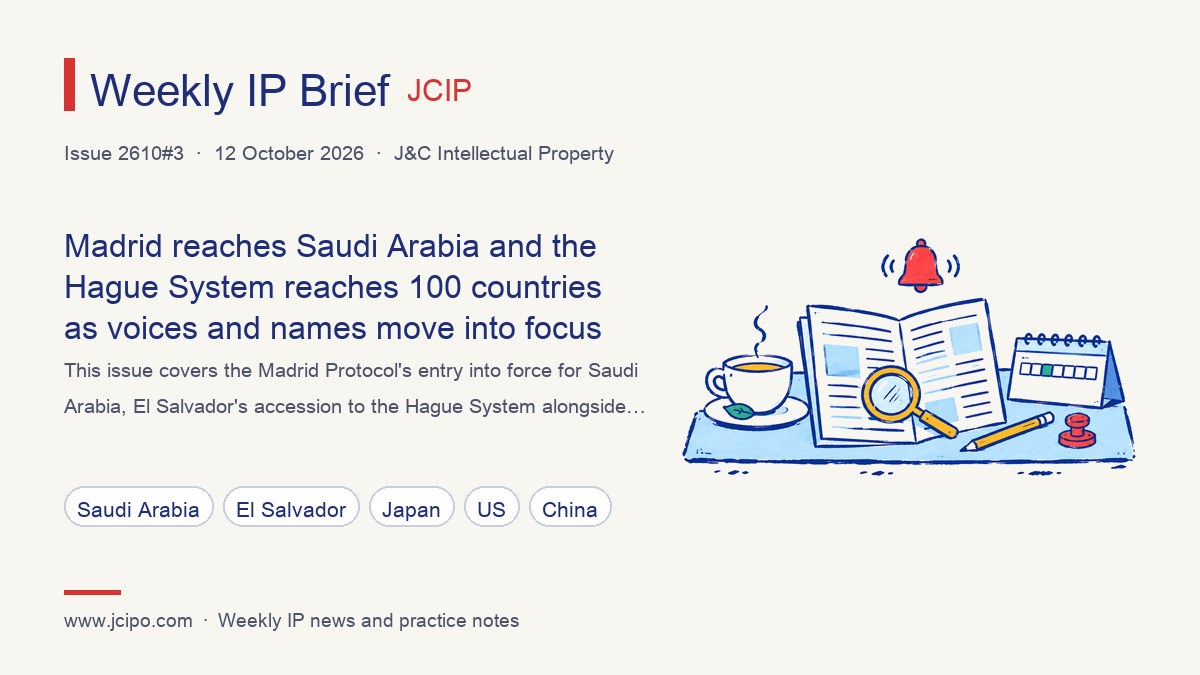
Weekly IP Brief issue 2610#3 cover: Madrid reaches Saudi Arabia and the Hague System reaches 100 countries as voices and names move into focus
Weekly IP Brief · Latest issue
Madrid reaches Saudi Arabia and the Hague System reaches 100 countries as voices and names move into focus
This issue covers the Madrid Protocol's entry into force for Saudi Arabia, El Salvador's accession to the Hague System alongside two procedural treaties, trade mark and personality protection for voices in the age of AI cloning, a US newspaper group's lawsuit against OpenAI and the Copyright Office's inquiry into streaming fraud, and the limits on using other parties' names in trade names, product names and union branding.

Latest Posts

29 March 2026

The IP5 offices — CNIPA, the EPO, the JPO, MOIP (formerly KIPO) and the USPTO — have jointly decided to extend the IP5 Patent Prosecution Highway (PPH) pilot for another three years, from January 6, 2026 to January 5, 2029. The offices also made clear that the requirements and procedures for filing PPH requests under the pilot will remain unchanged. In practical terms, applicants will still be able to rely on an existing and familiar work-sharing route to accelerate related patent applications across major jurisdictions at a time when examination efficiency, budget discipline and filing speed are becoming more tightly linked.

On its face, this looks like a routine renewal notice. In reality, it is a stronger policy signal about continuity. The IP5 did not use the renewal to rewrite the interface, narrow access, or impose new procedural burdens. Instead, it preserved a tool that applicants, in-house teams and external counsel already know how to use. For businesses trying to align patent timing with fundraising, licensing, product launch, freedom-to-operate planning or cross-border technology partnerships, the real value is not simply that PPH remains available. It is that the way to use it is not suddenly changing over the next three years.


29 March 2026

In March 2026, the EUIPO used a joint webinar to push the implementation signal of CP16 and CP17 into the market again. The two Common Practices focus respectively on when a sign describing the subject matter of goods or services may be refused as descriptive, and when a slogan can still function as a trade mark. What matters here is less a sudden statutory change than a broader shift in examination culture: issues that used to depend heavily on office-specific instincts are being pulled into a more structured and more predictable framework across European trade mark practice.

For brand owners, the significance is practical. European trade mark assessment is moving from a world where applicants merely know which examples are risky to one where they can increasingly anticipate the logic behind refusals. Read together with CP14 on public policy and morality and CP15 on the comparison of goods and services, CP16 and CP17 are not just two new documents. They are another step in aligning how offices analyse descriptiveness, promotional wording and filing specifications before disputes even begin.

29 March 2026

On 26 March 2026, Advocate General Nicholas Emiliou delivered his Opinion in Case C-579/24 Austro-Mechana and AKM, adding an important new layer to the licensing architecture for online content-sharing service providers under the EU Copyright in the Digital Single Market Directive. In his view, when users upload protected content to a platform, the process does not involve only an act of communication to the public or making available to the public; it also involves acts of reproduction in the form of digital copies made on the platform’s servers.

The real significance of the Opinion, however, is not that it creates a fresh licensing tollbooth. Emiliou also argues that the authorisation which an online content-sharing service provider must obtain under Article 17(1) of the DSM Directive for communication to the public or making available to the public necessarily extends to the technically required reproductions made on its servers in order to give the public access to that content. If the Court follows that approach, the practical result would be highly consequential: platform compliance, licensing negotiations with collective management organisations, and the allocation of responsibility between platforms and users would all move further toward a single integrated authorisation model rather than a stacked, double-licensing structure.

27 March 2026

On March 12, 2026, WIPO issued Information Notices MADRID/2026/7, MADRID/2026/9 and MADRID/2026/13, confirming that the individual fees under the Madrid System will be reduced for Australia, China and Japan as from April 12, 2026. For applications and subsequent designations, Australia will fall from 232 to 217 Swiss francs per class; China from 249 to 220 Swiss francs for one class and from 125 to 110 for each additional class; and Japan from 266 to 221 Swiss francs for one class and from 250 to 208 for each additional class. Renewal fees are also reduced for China and Japan, and for Australia the same lower per-class amount applies to renewals as well.

This is more than a routine fee update. For brand owners planning to cover Australia, China and Japan through a single Madrid filing strategy, the changes affect filing timing, class planning, subsequent designations and renewal budgets. Businesses with multi-class portfolios, renewals approaching in the second quarter of 2026, or expansion plans in Asia-Pacific should be recalculating now rather than treating the fee cut as a minor administrative footnote.

27 March 2026

China’s latest revision to the Patent Examination Guidelines, published by CNIPA at the end of 2025 and effective from January 1, 2026, makes the examination framework for inventions involving artificial intelligence, big data and algorithm-related features significantly more explicit. The revised text renames the relevant section to cover inventions involving AI, big data and other solutions containing algorithmic features or business rules and methods, while also adding a clearer Article 5(1) filter for content that violates law, social morality or the public interest.

This is more than a drafting clean-up. For applicants, R&D teams and patent firms, the revised framework shifts the focus from simply asking whether a solution “uses AI” to asking who the real inventors are, whether the data and decision logic are legally and ethically defensible, whether algorithmic features and technical features together form a real technical contribution, and whether model design or encoding-related subject matter has been disclosed with enough specificity to support patent protection. In the same revision package, CNIPA also introduced dedicated rules on bitstream-related claims, reinforcing the same policy instinct: abstract data outputs do not automatically deserve protection, but concrete technical methods tied to how such outputs are generated, stored or transmitted may.

27 March 2026

On November 11, 2025, the Maldives enacted the Trademark Act (Law 19/2025), which is scheduled to take effect on November 11, 2026. Compared with the country’s earlier reliance on cautionary notices to signal trademark claims, the new law introduces a structured framework for filing, examination, publication, opposition, registration, renewal and cancellation. In practical terms, this is a shift from informal notice-based protection toward procedural title-based protection.

Although the headline is about trademark legislation, the implications are broader for companies watching packaging, product appearance and design-related market entry. The Maldives Intellectual Property Office Act has already laid the institutional groundwork, and because the Maldives is not yet part of the Paris Convention or the Hague System, the way this new framework is implemented may matter well beyond trademarks alone.

27 March 2026

WIPO’s March 2026 PCT Newsletter highlighted a cluster of procedural developments that deserve close practical attention. Beyond the extension of certain PCT-PPH pilots, three updates stand out for their operational impact: the Patent and Trademark Office of San Marino will become both a depositing and an accessing Office of the WIPO Digital Access Service (DAS) from 1 May 2026; the National Patent Office of Bahrain will begin receiving and processing international applications in electronic form via ePCT-Filing from 1 October 2026; and the Indonesian Culture Collection (InaCC), under Indonesia’s National Research and Innovation Agency, has held the status of International Depositary Authority under the Budapest Treaty since 24 February 2026.

At first glance, these developments may look like separate technical notices. In reality, they point in the same strategic direction: the effectiveness of the PCT system increasingly depends not only on harmonized treaty rules, but also on the quality of its procedural infrastructure for priority document exchange, digital filing, and internationally recognized biological material deposits. For companies, research institutions and patent counsel, these changes may not alter patentability standards overnight, but they can materially affect filing readiness, evidence management and cross-border execution.