

Insights

Browse IP insights and practice updates

Unused Chinese marks face ex officio cancellation as Madrid fees and US examination practice shift

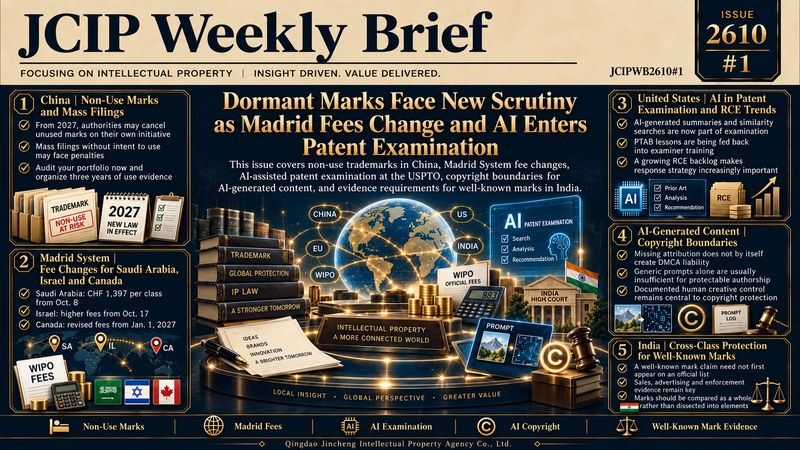
JCIP Weekly Brief

Issue: JCIPWB2610#1

This issue covers how China's new Trademark Law treats unused registrations and warehoused filings, the Madrid fee changes for Saudi Arabia, Israel and Canada, the AI tools and RCE trend on the USPTO's examination side, the copyright boundary of AI-generated content, and the evidence route to well-known-mark protection in India.


Latest Posts

01 October 2026

Peru's National Institute for the Defence of Competition and the Protection of Intellectual Property (Indecopi) reported on 29 September that its Specialised Chamber for Intellectual Property has confirmed on appeal the first-instance refusal to register copyright in 3 AI-generated images filed by the same applicant, titled 'Viejo Callejón de un solo caño', 'Café del Lunes' and 'Lomo Saltado en Taberna'. The Chamber stated that copyright protects personal and original intellectual creations, so a protected work must result from human creative activity, and that results generated exclusively by automated systems, algorithms or artificial intelligence cannot be regarded as protectable works under copyright law.

01 October 2026

On 30 September the China National Intellectual Property Administration (CNIPA) released in one go three implementing documents for the new layout-design regime for integrated circuits: new Implementing Rules of the Regulations on the Protection of Layout Designs of Integrated Circuits (CNIPA Order No. 86), Transitional Measures on examination matters following the revised Regulations (Announcement No. 694) and a revised Guide to Examination and Administrative Adjudication of Layout Designs (Announcement No. 695). The Transitional Measures take effect on 15 October, the same day as the revised Regulations, while the new Rules and the new Guide take effect on 30 October, repealing the 2001 Rules (Order No. 11) and the 2019 trial Guide to Examination and Enforcement.

01 October 2026

A Chinese trademark registration lasts ten years, but keeping it valid takes more than paying the renewal fee once a decade. Renewals have a fixed window, every change of the owner's name or address has to be recorded, and assignments follow rules that surprise foreign owners. This guide covers what has to be filed, when, and what goes wrong if it is not.

01 October 2026

Thailand's Department of Intellectual Property (DIP) announced on its website on 30 September that it has linked the trade mark search system IP Search with the company registration data of the Department of Business Development (DBD): when searching a trade mark, the public and businesses can now immediately check the current status of the juristic person recorded as owner, as information to consider before a trade mark transaction or other disposal. According to the DIP press release issued on 29 September in the name of Director-General Oramon Sapthaweetham, the trade mark record in IP Search now displays an entry point for checking juristic-person status that links to the DBD DataWarehouse+, so the data comes directly from the authority responsible for company registration. Users can see at once when the owner is in a status such as dissolved with liquidation pending, dissolved with liquidation completed, or defunct and struck off.

30 September 2026

Trademark rights are territorial: a registration in one country gives no protection in another. Exporters therefore end up managing a portfolio spread across several offices with different rules on filing basis, examination, opposition and use. This guide summarises the points that matter most in ten jurisdictions our clients file in most often. Figures are indicative for 2026 and change; always confirm current fees and timelines before budgeting.

29 September 2026

Canada's regulator of patent and trade mark agents, the College of Patent Agents and Trademark Agents (CPATA), updated its scam warning for Canadian businesses and IP rights holders again on 28 September; the page was first published on 14 January 2025 and the updated list of schemes includes impersonating the Canadian Intellectual Property Office (CIPO) or agencies by email, text and phone, demanding false trade mark renewal fees, claiming that a third party is applying to register your trade mark and creating urgency by pointing to Canada's first-to-file system in place since 2019, and fake opposition notices designed to create urgency.

29 September 2026

The Mexican Institute of Industrial Property (IMPI) published in the Diario Oficial de la Federación on 28 September an Acuerdo establishing administrative simplification measures for various procedures before IMPI (trade mark applications), which substantially simplifies trade mark filing and merges application types and forms: the former separate procedures for traditional marks, collective marks, certification marks, slogans and the publication of trade names are consolidated into a single IMPI-01-001 'application for protection of distinctive signs'. Applications for non-traditional marks, namely holographic, sound, scent and trade dress marks and combinations of them, are consolidated into IMPI-01-002, which likewise covers collective and certification marks.