

Insights

Browse IP insights and practice updates

Unused Chinese marks face ex officio cancellation as Madrid fees and US examination practice shift

JCIP Weekly Brief

Issue: JCIPWB2610#1

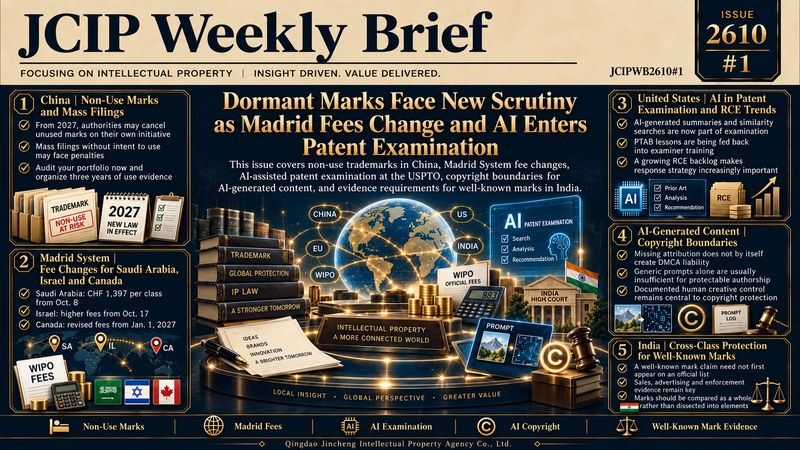
This issue covers how China's new Trademark Law treats unused registrations and warehoused filings, the Madrid fee changes for Saudi Arabia, Israel and Canada, the AI tools and RCE trend on the USPTO's examination side, the copyright boundary of AI-generated content, and the evidence route to well-known-mark protection in India.


Latest Posts

29 September 2026

Trademarks are registered by class. The Nice Classification divides goods into classes 1 to 34 and services into classes 35 to 45, and CNIPA further splits every class into numbered sub-classes. Choose the wrong class and the registration will not protect the business it was meant for. These are the six classes that applicants get wrong most often.

28 September 2026

A refusal notice from the China National Intellectual Property Administration (CNIPA) is not the end of the application. The applicant has 15 days from receipt to decide what to do, and the best option depends on why the mark was refused and on how much the brand is already worth to the business.

28 September 2026

Indian practitioners have been discussing since 26 September an earlier Delhi High Court judgment in ZARA v ZORA: the court held that when a proprietor invokes Section 11(2) of the Trade Marks Act 1999 to protect a well-known mark across classes, the statute imposes no precondition that the mark must first have been formally declared well known under Rule 124, and the court or the Registrar may decide the point in the case at hand on the factors in Section 11(6) and related provisions. The judgment was delivered by Justice Jyoti Singh on 6 July 2026 (C.A.(COMM.IPD-TM) 52/2024) on Inditex's appeal under Section 91 against the Registrar's order of 8 February 2024, which had dismissed Inditex's opposition 1188767 to the mark ZORA.

28 September 2026

A copyright case decided by Changsha's Kaifu District People's Court has become the focus of professional discussion after being reported in the media: the court divided the process of producing AI-generated content into three layers, front-end conception, generation control and back-end processing, examined originality layer by layer, and held that the image in dispute is not a work within the meaning of the Copyright Law, dismissing all of the plaintiff's claims. According to a report by Xiaoxiang Morning Post on 22 September, a third party generated the image on 8 May 2025 with the Jimeng AI image model by entering the prompt 'Dragon Boat Festival sachet, colourful, Chinese style, with the Chinese characters for Dragon Boat Festival'.

27 September 2026

The United States Patent and Trademark Office (USPTO) announced on 22 September the appointment of Jonathan Spencer as Chief Artificial Intelligence Officer (CAIO), overseeing AI and emerging technology matters within the agency, ensuring that the USPTO deploys innovative technologies in service of innovators and working with agency leadership to modernise, develop and deploy AI systems and technology; Spencer previously developed autonomous driving logic at Waymo and co-founded several AI start-ups. The next day, USPTO Chief Information Officer Deborah Stephens disclosed at an ACT-IAC webinar, as reported by FedScoop and other outlets, that the Office has launched more than 20 AI capabilities with more planned: the enterprise large language model tool Scout has over 7,000 daily and weekly users, and an AI plugin has summarised over 100,000 applications for patent examiners.

27 September 2026

China is a first-to-file jurisdiction. Every year foreign brands enter the market without a registration and find that a distributor or a third party has filed their name first. These are the eight points foreign applicants most often overlook.

27 September 2026

This is the question we are asked most often in international trademark work. Below is a comparison on the six points that matter most to brand owners.